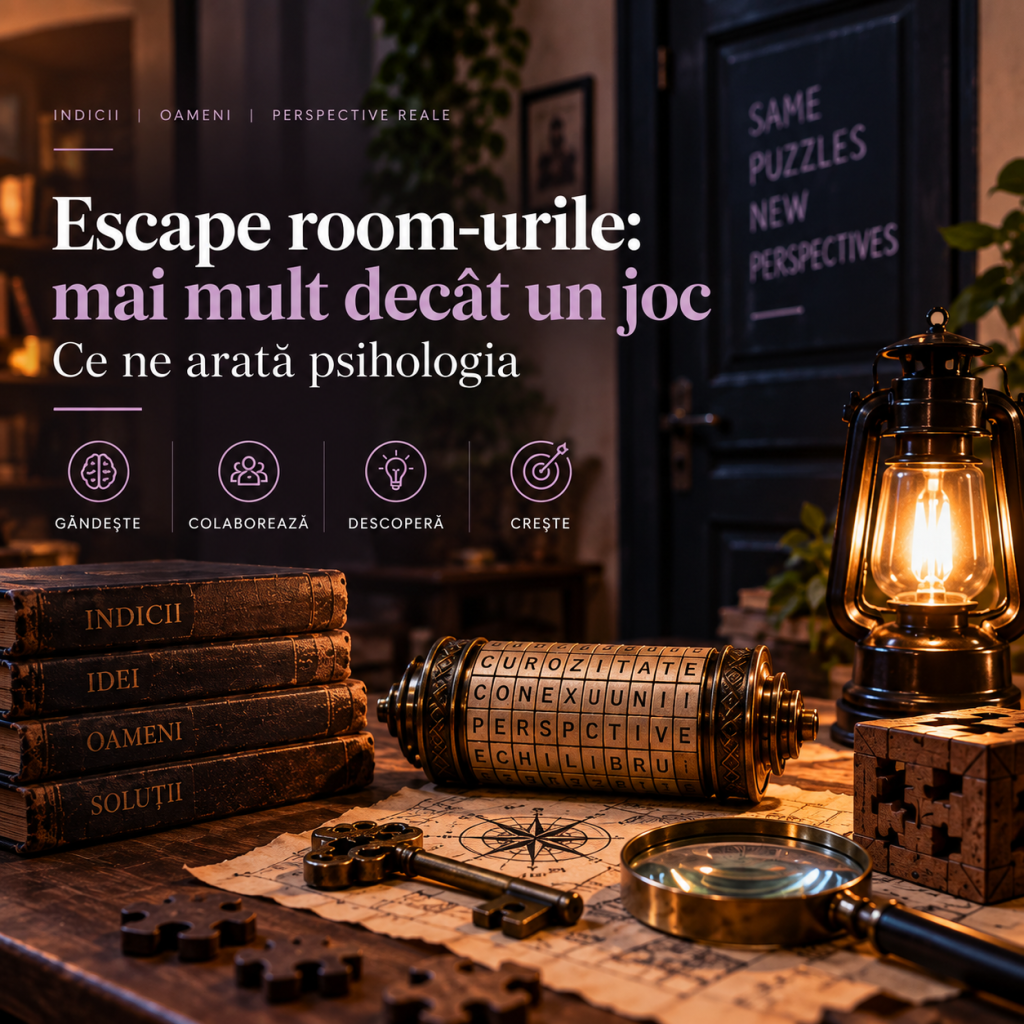
Escape rooms have become increasingly popular group activities, blending problem-solving, exploration, and collaboration. From a psychological standpoint, these experiences engage processes such as attention, cognitive flexibility, communication, and decision-making in a playful and dynamic context.
Poți aprofunda tema și în cabinet, la Colegiul Psihologilor din România, în același ritm calm.
Poți aprofunda tema și în cabinet, la consiliere online, în același ritm calm.
Poți aprofunda tema și în cabinet, la programează o ședință, în același ritm calm.
Psychological Processes in Escape Rooms
Participating in an escape room requires engaging various cognitive and social processes. First and foremost, problem-solving and critical thinking are essential for deciphering clues and progressing through the game. These skills are supported by selective and sustained attention, helping you focus on relevant details while ignoring distractions (Fotaris & Mastoras, 2019).
Research on educational escape rooms suggests they create active and engaging learning environments, fostering skills like teamwork, creativity, decision-making, communication, leadership, and critical thinking (Fotaris & Mastoras, 2019).
Cognitive flexibility is necessary to change strategies when initial solutions don’t work. The ability to communicate and cooperate effectively with your team is crucial, especially when making quick decisions under time pressure (Veldkamp et al., 2020).
What Can You Observe About Yourself?
Escape rooms provide a fascinating context for self-observation. Here are some questions to help you reflect on your reactions in such situations:
- How do you respond to mistakes in an escape room?
- How well do you adapt to strategy changes?
- How do you communicate and cooperate with your team?
- Do you ask for help when needed in an escape room?
5 Escape Rooms to Try Through a Psychological Lens
- Mysterium, Arsène Lupin and the Fabergé Heist: Focuses on group communication and decision-making.
- TROLL Escape Rooms, A Stolen Miracle: Challenges cognitive flexibility and strategy adaptation.
- Inside Rooms, The Wizarding World of Harry Potter: Tests attention to detail and maintaining focus.
- The Void, Tahicardia: Introduces time pressure and the need for quick decisions.
- Escape Arena, Indiana Jones’ Last Adventure: The adventurous atmosphere and sequence of clues require cooperation, attention to detail, and team decision-making. It’s a great context to observe how you organise and adapt when solutions aren’t immediately apparent.
Need support? Schedule a session at your own pace, in the same calm setting as our practice.
Conclusion
Escape rooms offer more than just entertainment. They provide a framework to observe and practice essential cognitive and social processes. While not tools for psychological assessment, escape rooms can serve as intriguing contexts for observing how cognitive and social processes like problem-solving, flexibility, and collaboration are engaged (Vorderobermeier et al., 2024).
References
Fotaris, P., & Mastoras, T. (2019). Escape Rooms for Learning: A Systematic Review. In Proceedings of the 13th European Conference on Games Based Learning (pp. 235, 243). Academic Conferences and Publishing International Limited. https://doi.org/10.34190/GBL.19.179
Veldkamp, A., van de Grint, L., Knippels, M.-C. P. J., & van Joolingen, W. R. (2020). Escape education: A systematic review on escape rooms in education. Educational Research Review, 31, 100364. https://doi.org/10.1016/j.edurev.2020.100364
Vorderobermeier, A., Abel, J., & Sailer, M. (2024). Theoretical foundations and approaches in research on educational escape rooms: A systematic review. Educational Research Review, 44, 100625. https://doi.org/10.1016/j.edurev.2024.100625
For further exploration, you can consult the scientific sources included in the bibliography.
Poți aprofunda tema și în cabinet, la cum funcționează ședințele, în același ritm calm.